

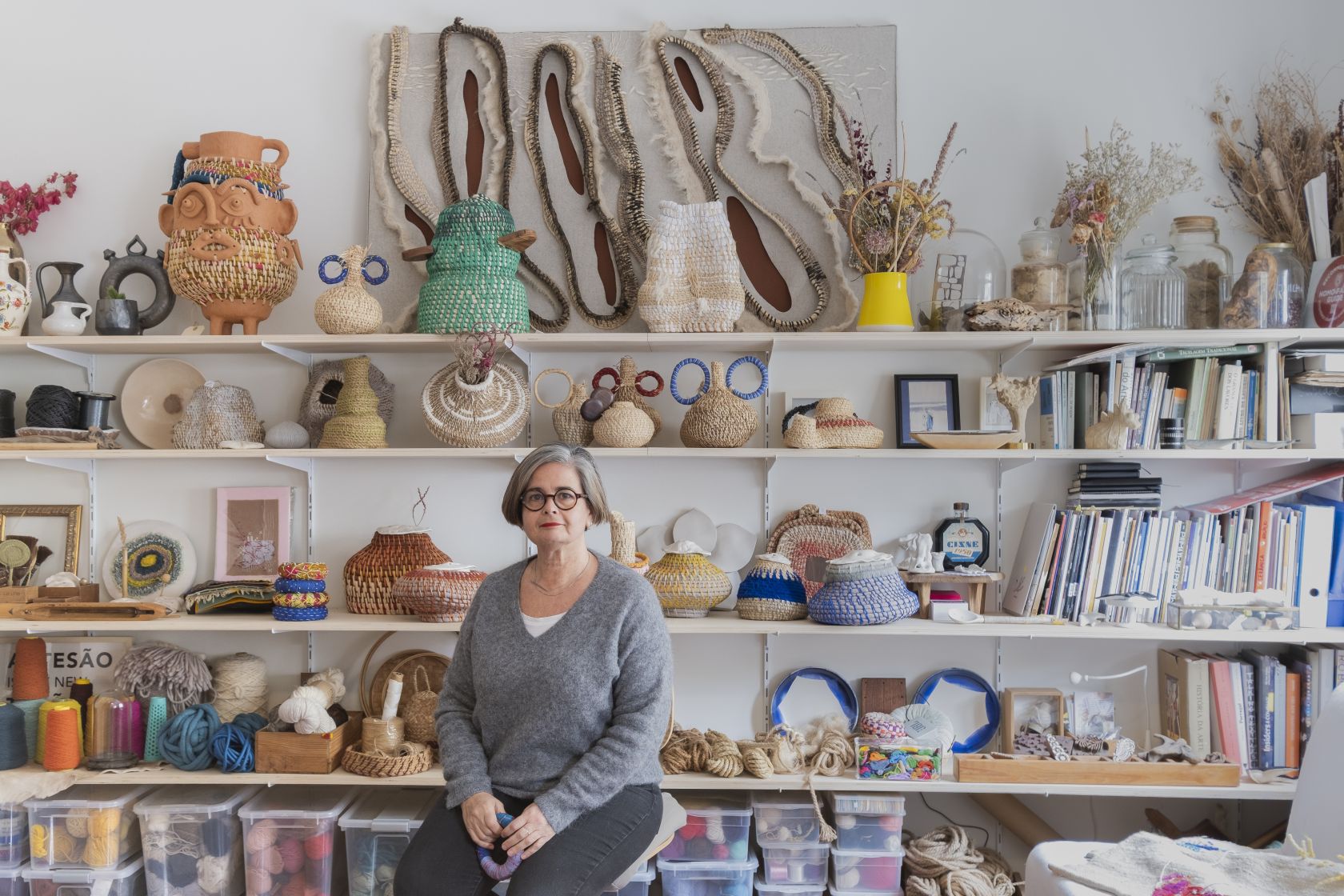
Born in Coimbra, she studied Visual Education there, but her curiosity for materials and their potential revealed an instinctive connection early on. Maria has always been drawn to the way a thread bends, how a surface resists, and how a form emerges from gesture. She felt she could create objects in countless ways, guided by her creativity and intuition.
From Image to Materiality
Studying visual education made image-making a constant in her life, showing how two-dimensionality conveys messages, highlights details, and evokes beauty, even from images in magazines before the digital era. Yet, she sensed something was missing: materiality and its physical, sculptural possibilities. Textiles offered her freedom, the ability to build, draw in the air, and give shape to stories and observations.
“It wasn’t a rational choice. It was a recognition, like finding a language you’ve spoken all along without knowing. For me, raw materials have a will of their own. Learning to listen to that will, letting materials tell me how far I can go, what tension they can hold, what gesture they ask for - is a silent dialogue where I lead, but am also led. It’s a deeply pleasurable challenge.”
Sources of Inspiration
Maria finds inspiration in the beauty of things: the gestures of those who work with their hands, the power of standing before a work of art, and the landscapes of Portugal, especially the Vicentine Coast, where wind, light, and water shape her perception.
Creative process
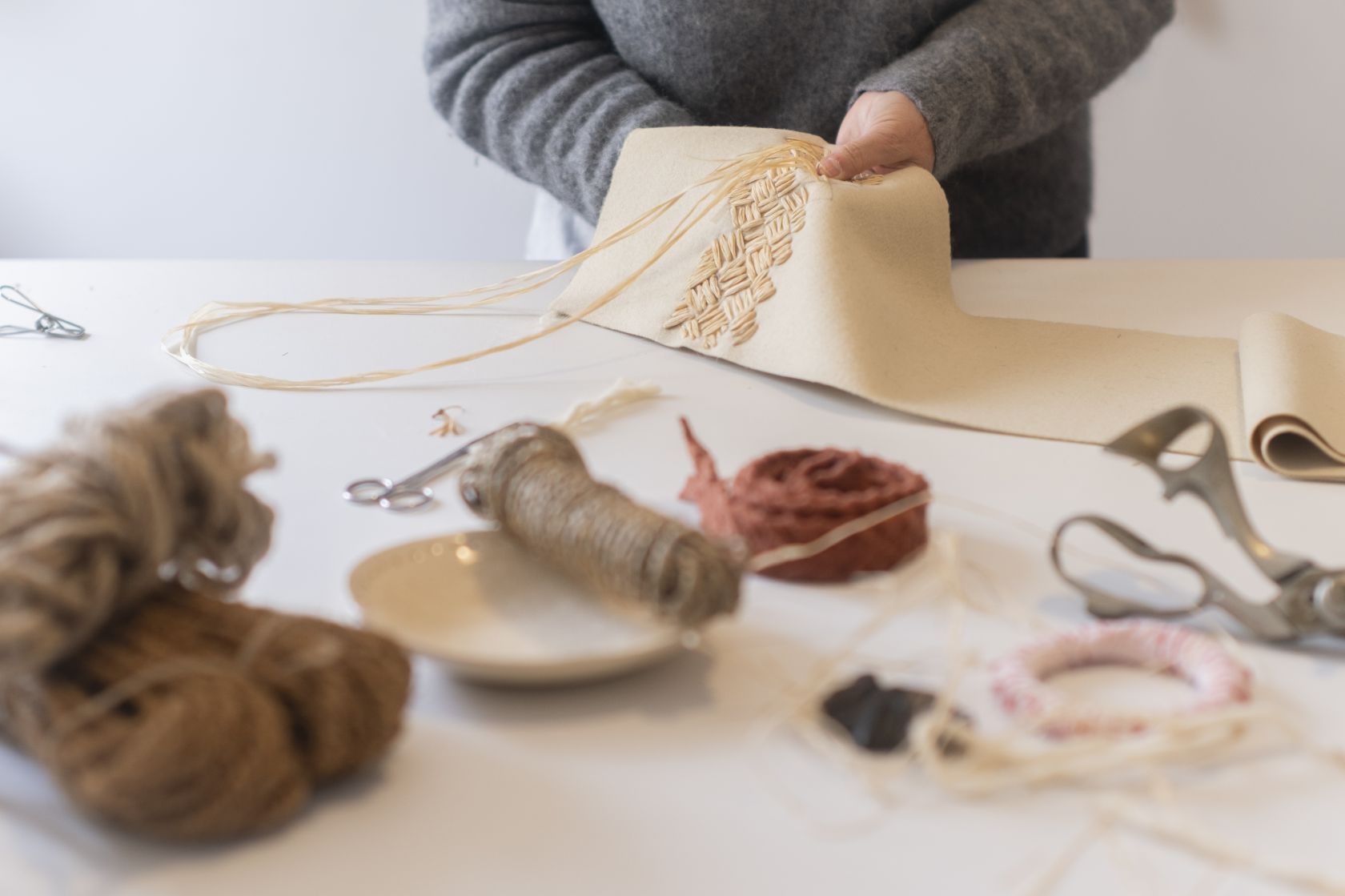
Her creative process is ritualistic yet intuitive. She usually begins by choosing the right music for that moment, preparing a cup of her favourite tea. An important part is letting natural light flood her studio. Then, she gathers materials, sketches initial gestures in a notebook, and arranges elements like a mood board. The hands-on dialogue begins, and when a piece feels complete “breathing on its own”, she knows it is finished. Her favourite moment is the crescendo of creation: the conception of the space, the sketches, the mood board, and finally the first gesture.
There is no typical day in Maria’s studio. Some days are for creating, others for observing or waiting, and many for producing. The studio follows its own rhythm.
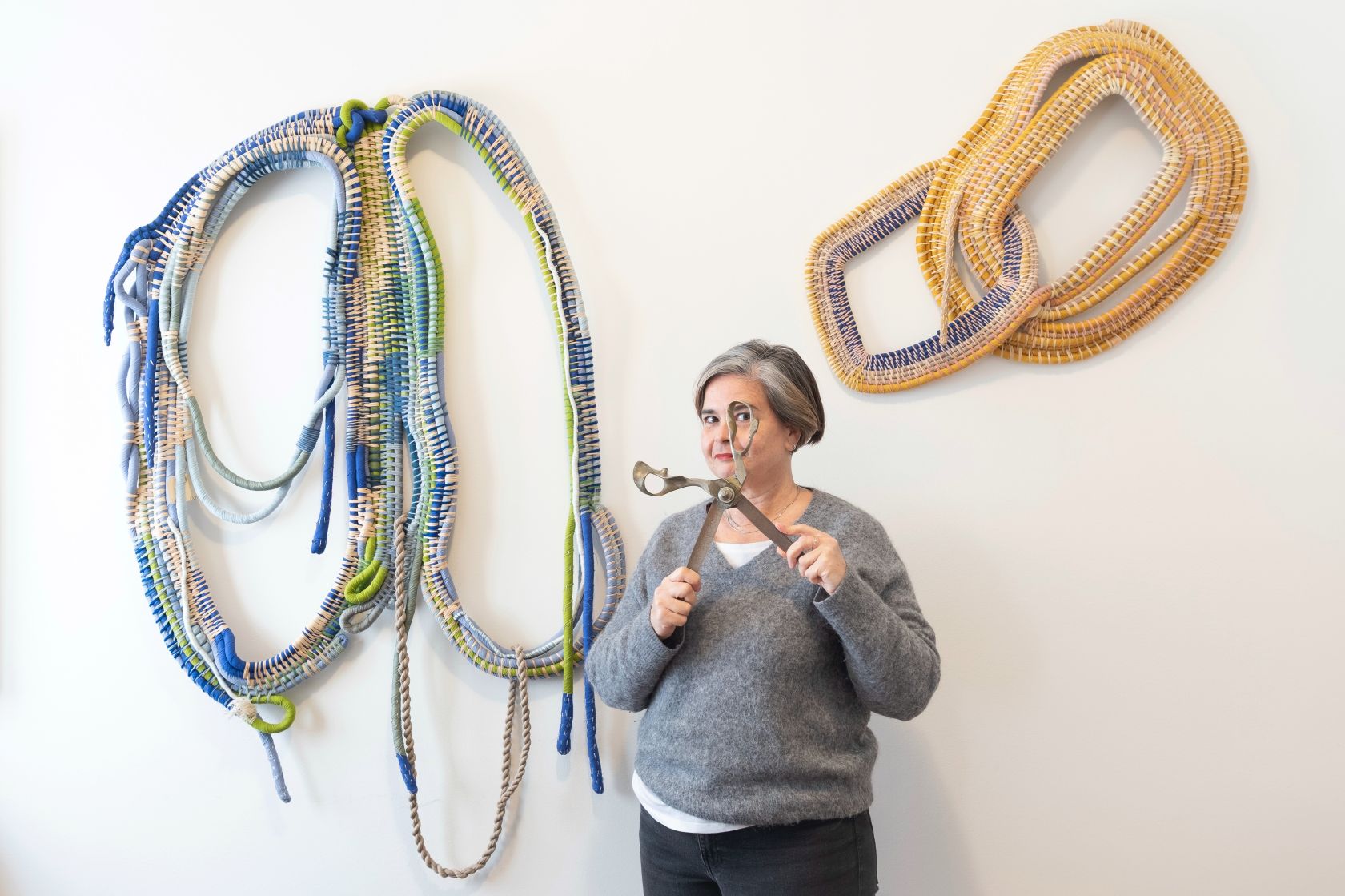
Maria’s techniques, including coil basketry and textile weaving, are approached in a sculptural and inventive way. “I use craft techniques as a language, not as a destination. I like to push them, distort them, reinvent them, respecting their ancestry but without being limited by it.”
She believes objects carry emotional memory. Every material holds layers of time. Memories of hands, landscapes, and origins, and her work adds another layer to that continuum. Reuse and repurposing are central to her practice. Maria often collects found materials, like ropes from the beach, which bring their own history and vibration.
Materials as Language
Texture, for Maria, communicates as directly as words or images. “Texture speaks to the body, through sight and touch, allowing people to know a work without translation.” Light and shadow are equally integral: “Light completes the gesture; shadow reveals what the thread hides.”
Having exhibited at Lisbon Design Week and collaborated with platforms such as Homo Faber, Maria sees a fertile crossroads in Portugal today, where craft, art, and design increasingly converge. She observes that younger generations are reconnecting with craft traditions, not as relics of the past, but as living knowledge. Craft gains strength when the maker is valued, when manual knowledge is recognised as research rather than ornament.
“I don’t see tradition and technology as opposites. Many contemporary pieces combine advanced techniques with ancestral materials like wicker, linen, and clay. Innovation doesn’t erase origins; it expands them. AI is just another tool that opens possibilities without replacing material knowledge. The future of craft lies in this coexistence: the continuity between what we inherit and what we invent.”
New directions
Currently, Maria is exploring a new chapter in her practice: drawing through textile. By reinterpreting embroidery techniques, she is creating a direct, graphic language on textile surfaces. This approach shifts traditional methods and opens new relationships between line, gesture, and material.
While Maria was born and raised in Coimbra, her creative life now spans Lisbon and Praia da Ingrina, a rhythm of work, creation, and breathing space.
Maria Pratas’ work is a meditation on material, memory, and gesture - a dialogue between the hand, the thread, and the light, where every piece carries the pulse of both heritage and invention.
Discover more about Maria’s art on her Instagram page @ _maria_pratas_








 English
 Nederlands
 Deutsch
 Français
 Español
 Italiano
 Svenska
 Pусский
 中文
中文 Türkçe
 Português
 Polski
 عربي
عربي Suomi
Suomi עִברִית
 Português (Brasil)