

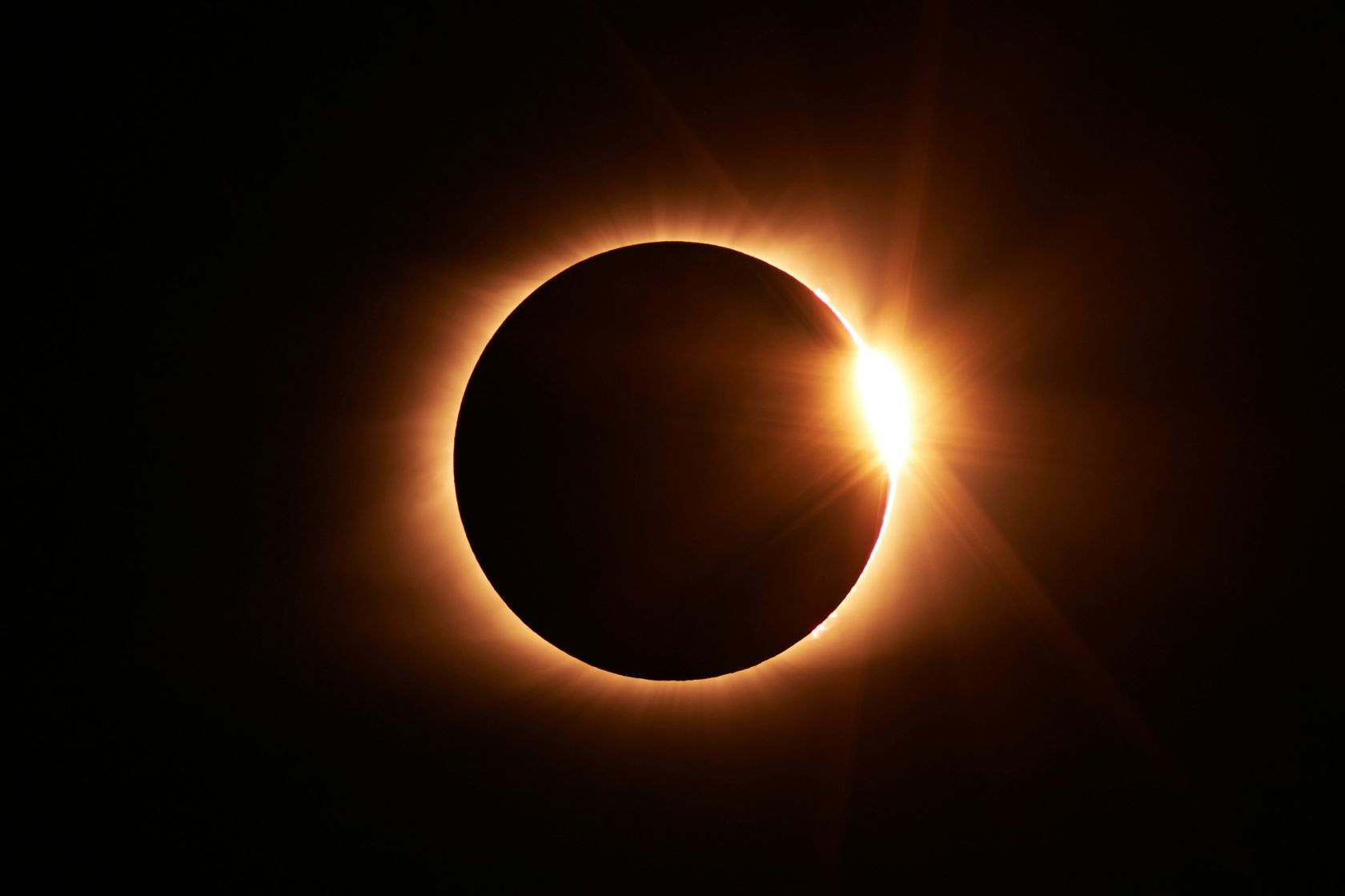
One of the most remarkable astronomical phenomena of the century can be seen in Portugal, with levels of sun obscuration between 92% and 100% in mainland Portugal, in what is a long-awaited solar eclipse.
The totality of the eclipse will be visible in Trás-os-Montes for 26 seconds. The solar eclipse will be fully visible in the Montesinho Natural Park, as explained by the Ciência Viva Agency on its website dedicated to the solar eclipse predicted for 2026. Quoting the agency, the eclipse “will show the effect of a Diamond Ring in the sky. Seconds later, the single ray of sunlight fragments into multiple points of light known as Baily's Pearls. In totality, the Sun disappears completely, revealing the Solar Corona, impossible to see at any other time.”
Quoted by SIC Notícias, Ricardo Cardoso Reis, from the Institute of Astrophysics and Space Sciences (IA), reveals that the phenomenon will “be very worthwhile as the path of totality will pass right next door, between northern and eastern Spain, in cities such as Gijón, Valladolid, Bilbao, Zaragoza or Valencia.”
In Portugal, the totality of the eclipse can be seen with greater intensity in the village of Guadramil, in the district of Bragança.
Watching in a group
There are already some events planned for the historic day, especially in the only place in Portugal that is in the zone of totality, the Montesinho Natural Park.
For 12 August, there are already events scheduled so that people can get together and see the eclipse, mainly in the Montesinho Natural Park, where the eclipse will be seen in its entirety.
The Ciência Viva Agency will have events starting at 6:30 pm in Bragança, along with the Institute of Astrophysics and Space Sciences and the Bragança City Hall.
Scheduling
The peak of the eclipse should occur at 7:30 pm, coinciding with sunset, and the eclipse may end after the Sun disappears below the horizon.
Even though the total phase of the eclipse lasts only a few seconds, the phenomenon still lasts a few minutes. The partial eclipse will begin at 6:33 pm, the total eclipse will begin at 7:30 pm, lasting only 25 seconds. The partial eclipse, in turn, will end at 8:23 pm.
Why does a solar eclipse happen?
A solar eclipse is nothing more than a play of shadows between the Moon, the Earth, and the Sun. A solar eclipse occurs when the Moon is positioned between the Earth and the Sun, projecting its shadow onto the planet Earth.
Precautionary measures
Looking directly at the sun is dangerous and can cause eye injuries. Therefore, observation should be done with caution, using appropriate safety equipment, such as certified filters or through indirect methods.
Event of the century
The last time Portugal witnessed a total solar eclipse was in 1912, and after 2026, the phenomenon may only repeat itself in 2144.








 English
 Nederlands
 Deutsch
 Français
 Español
 Italiano
 Svenska
 Pусский
 中文
中文 Türkçe
 Português
 Polski
 عربي
عربي Suomi
Suomi עִברִית
 Português (Brasil)