

An investigation published on Tuesday, 12 May, by the German outlet Table. Briefings, based on confidential internal European Commission documents, raises serious questions about the transparency and integrity of the selection process for “Strategic Projects” under the European Critical Raw Materials Act (CRMA).
According to the investigation, eleven projects absent from a preliminary list dated 20 February 2025 later appeared in the final list of projects presented in March 2025. This occurred despite indications that they had not received favourable assessments during an initial technical evaluation conducted by external experts. The changes reportedly took place following consultations between the European Commission and Member States within the framework of the Critical Raw Materials Board.
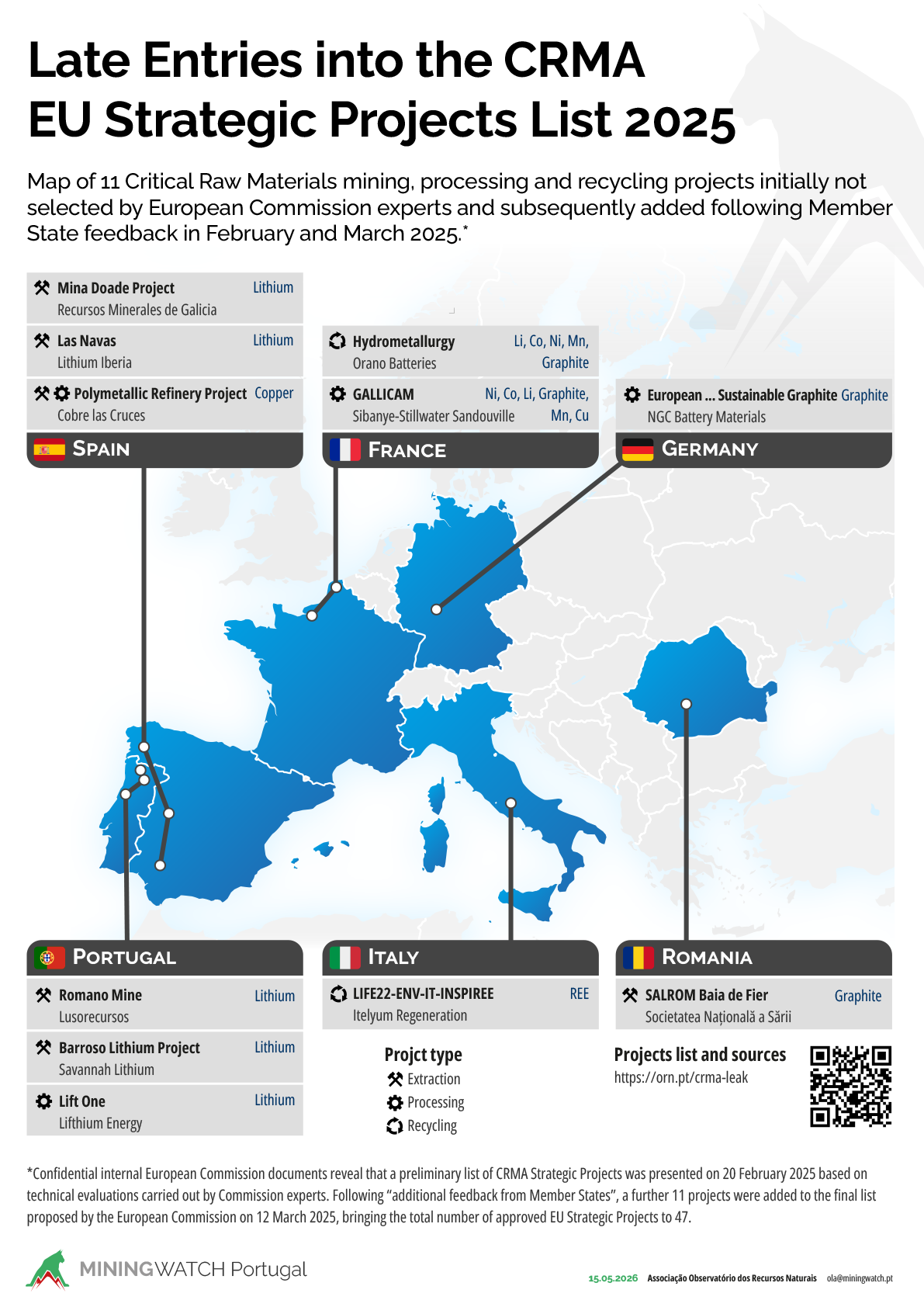
Among the projects later added are several controversial mining and raw materials processing projects in Portugal and Spain. A comparison between the preliminary and final lists shows that Portugal alone saw three projects added between February and March 2025: Savannah Lithium’s Barroso lithium mine, the Romano mine project by Lusorecursos, and the Lift One lithium refinery project by Lifthium Energy (José de Mello, Bondalti).
Michael Reckordt, raw materials policy advisor at PowerShift Germany, stated that “the process raises serious concerns that environmental, human rights and social criteria played little role in the final selection of Strategic Projects. For affected communities contesting these projects for years, this is deeply troubling.”
The revelations are particularly significant in Portugal, where all lithium projects currently classified as Strategic Projects at EU level appear among the projects later incorporated into the final selection process. The leaked documents further raise questions regarding the role played by certain Member States during the selection phase, as projects were added also in Spain (3), France (2), Germany (1), Italy (1) and Romania (1).
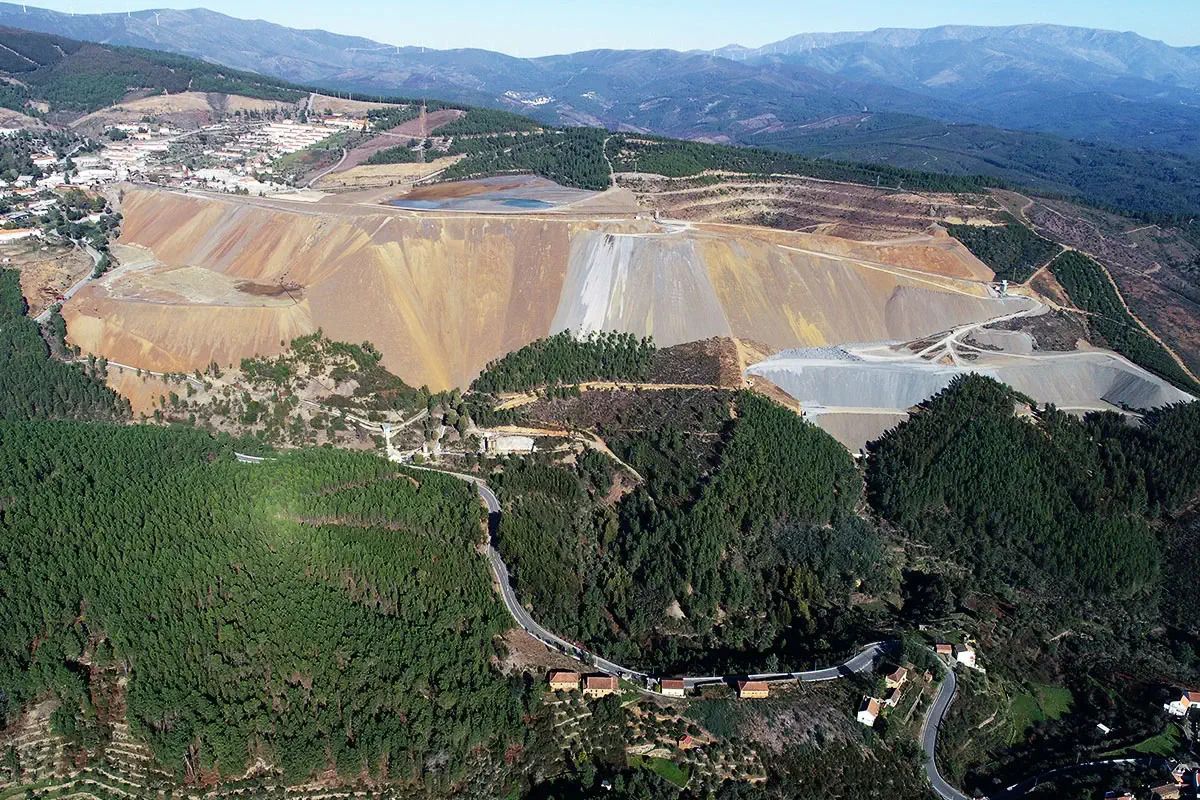
The Barroso lithium project in northern Portugal, promoted by Savannah Lithium, is currently being challenged before the General Court of the European Union by the local association Unidos em Defesa de Covas do Barroso (UDCB) and ClientEarth. The case raises concerns over water resources, biodiversity, public participation and tailings dam safety. On 6 May 2026, a second administrative servitude was also published, granting the company temporary access to private and common lands for further geological and geotechnical exploration works.
Catarina Alves of the local association UDCB said: “The Strategic Project classification has already concrete impacts on the territory through the second administrative servitude affecting 228 hectares of private and common lands. The leaked documents reinforce our concerns that political interests prevailed over environmental safeguards, transparency and citizens’ rights.”
The Table.Briefings investigation also reports that the European Commission repeatedly refused requests for access to technical assessments and internal evaluation documents submitted under EU access to documents legislation and the Aarhus Convention, invoking reasons related to public security and the protection of economic and commercial interests.
For affected communities and civil society organisations across Europe, these revelations reinforce longstanding concerns regarding the governance of mining and lithium projects within the framework of the EU’s strategic raw materials agenda, amid growing political controversies and social conflicts linked to extractive projects.
Nik Völker, co-founder of MiningWatch Portugal, stated: “The opaque selection procedures, unpublished technical assessments and repeated refusals of access to environmental information raise serious concerns about the governance culture around the strategic mining projects in Europe and beyond. Even now, the public does not know who the allegedly independent experts were, what affiliations they may have had, or whether possible conflicts of interest were properly examined.”
The CRMA was presented by the European Union as a strategic instrument to secure access to raw materials needed for the energy transition while upholding high environmental, social and governance standards. However, environmental organisations, legal experts and affected communities increasingly warn that the implementation of the legislation is moving in the opposite direction: accelerating permitting procedures, limiting public scrutiny and increasing political pressure around controversial industrial projects.
The controversy surrounding the Strategic Projects selection process also emerges at a moment when the European Commission is considering revisions to the Water Framework Directive, one of the EU’s central environmental safeguards, explicitly aimed at removing “regulatory bottlenecks” linked to critical raw materials and industrial projects. Environmental organisations and researchers have warned that weakening the Directive’s non-deterioration principle could significantly reduce protections for rivers, groundwater and drinking water resources in favour of mining and industrial development.
Although Strategic Project status does not replace national permitting procedures or environmental law, it substantially increases political and economic pressure on authorities responsible for approving projects. Against a backdrop of growing conflicts around mining, lithium extraction and industrial land use across Europe, the revelations intensify broader debates on democratic transparency, environmental justice, access to environmental information and the role of local communities in decisions shaping Europe’s energy and industrial transition.






 English
 Nederlands
 Deutsch
 Français
 Español
 Italiano
 Svenska
 Pусский
 中文
中文 Türkçe
 Português
 Polski
 عربي
عربي Suomi
Suomi עִברִית
 Português (Brasil)
Thank you for publishing this. I hope to see it elsewhere in the Portuguese media, but I'm not holding my breath. The Portuguese media are always doubleplus goodthinkful (as we say in Newspeak), particularly regarding the European Union. They love to portray it as an oasis of freedom and democracy, and any news that contradicts this illusion is routinely ignored, or at least downplayed.
Also, I wonder what the reaction of the Portuguese government will be? OK, that was a rhetorical question!
By Mark from Porto on 05 Jun 2026, 14:31