


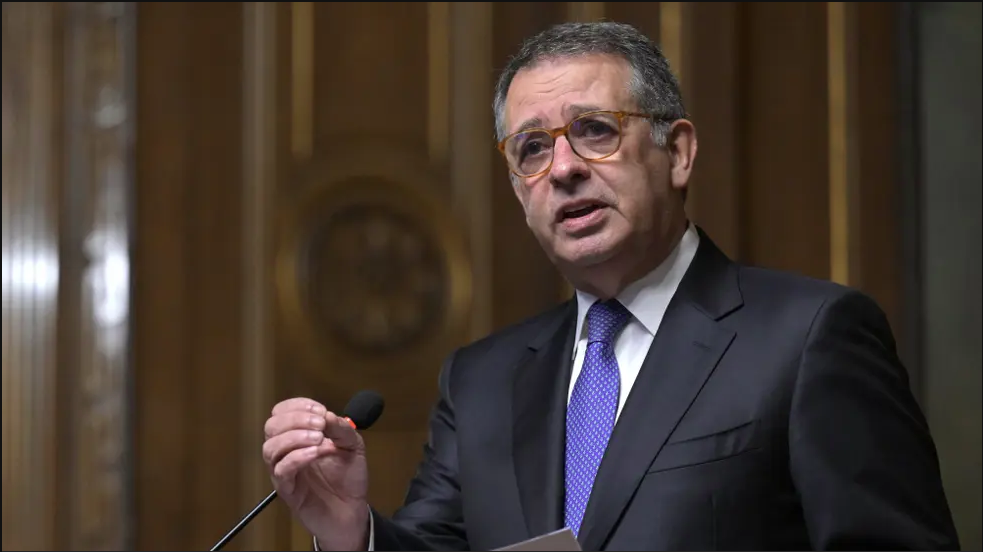
Conversely, after the reading of António José Seguro's message by the Vice-President of Parliament, the socialist Marcos Perestrello, the Chega bench reacted with protests.
"There will be a new discussion on this topic," commented the Vice-President of the Assembly of the Republic, when he sought to interrupt the exchange of asides between left-wing parliamentary deputies and Chega.
On 17 April, Parliament approved in general, in detail, and in final global voting a decree that originated from the CDS on rules for the use of flags in public buildings. This decree then had the favorable votes of the PSD, Chega, and CDS-PP, against from PS, PAN, Livre, BE, and PCP, and the abstention of IL.
Reason for the veto
On June 10, however, the Head of State announced that he had vetoed this decree, and his reasoning was released on June 11, at the beginning of the plenary session of the Legislative Assembly. This was António José Seguro's first political veto as President of the Republic.
In the letter, the President of the Republic justifies his veto of the Parliament's decree on the use of flags on public buildings with the distinction between "humanitarian causes with express constitutional and conventional recognition" and "political-partisan positions."
He states that, in exercising this veto, he does not ignore or undervalue the "legitimate concerns that would have guided the legislative initiative, notably that of preserving the dignity and neutrality of the State's institutional spaces."
"Nevertheless, it cannot be ignored that humanitarian causes with express constitutional and conventional recognition are in a different position from political-partisan positions, insofar as the State has already made normative commitments in relation to these," the message says.
The Head of State argues that domestic law “incorporates the instruments of international law that bind Portugal, including the Charter of the United Nations, the Universal Declaration of Human Rights and the Paris Agreement.”
He also warns that there is “no impediment to raising flags that symbolize humanitarian causes, provided that this is done in an appropriate context, with proportionality and without deviating from the purposes of the office.”
The Head of State insists that raising these flags “is rooted in our constitutional values and principles and in the international commitments of the Portuguese State, ruling out any interpretation of political-electoral instrumentalization.”
In addition, the President of the Republic also raises questions about the decree approved by Parliament, starting with the use of “indeterminate concepts, which contribute nothing to the clarity of the law, as well as to its correct application.”
Undefined factors
António José Seguro points to the concepts of "ideological flag" and "associative flag" as examples, which are not defined in the decree, "allowing speculation and uncertainty about their fulfillment and, naturally, about the application, or not, of the legal provisions that are intended to be implemented in the legal system."
Secondly, the President of the Republic points to "legal confusion between the entity applying and the entity overseeing the law."
"That is, it places the potential offender in the position of self-monitor," he argues.
The Head of State also points out that the function of applying fines is attributed to the district judge, "in proceedings instructed by the Public Prosecutor's Office," a solution that Seguro considers to be "legally atypical."






 English
 Nederlands
 Deutsch
 Français
 Español
 Italiano
 Svenska
 Pусский
 中文
中文 Türkçe
 Português
 Polski
 عربي
عربي Suomi
Suomi עִברִית
 Português (Brasil)
I wish the supposedly leftwing parties - in Portugal and in other countries = would get back to important issues like protecting workers' rights, strengthening public health and education systems, affordable housing, and so on. Instead, these days they spend nearly all their time promoting woke ideology and virtue signaling. They might as well all join the AD - if the AD would have them!
By Mark from Porto on 12 Jun 2026, 14:15
Of course, because that's what the regressive Left does, namely, promote anything and everything that is socially pathological in nature. The state should be a neutral arbiter and has no business promoting lifestyles and activities that, if allowed to fester universally, would lead to social and human extinction. And hey, if the Portuguese president really wants to be known for his "inclusivity", why not allow the swastika flag to fly also? Few in number no doubt, but I bet there are quite a few Portuguese National Socialists that would love to be included as a diverse part of their society. After all, diversity is a society's greatest strength, is it not?. So put your money where your mouth is or stop all this relativistic nonsense about "inclusivity" when the very people championing it use the term as a mantra to exclude others they hate.
By Tony from USA on 12 Jun 2026, 22:20