

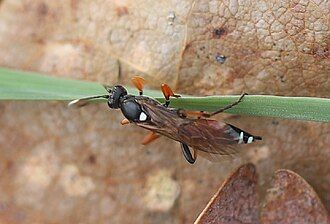
A biologist has found, in Baião, the first ever record of the wasp species “Exephanes ischioxanthus” in Portugal.
Daniel Ferreira, a researcher at the Landscape Laboratory in Guimarães, photographed the species in 2020 in Baião, in the Porto district, within the Serra da Aboboreira Protected Landscape. The findings were later published in April in the journal “Arquivos Entomolóxicos”, in an article co-authored with biologist José Manuel Grosso-Silva.
“This is the first recorded and confirmed instance of this species in Portugal,” the researcher told Lusa. “It belongs to a family that has thousands and thousands of species, very similar to each other. (…) [This one is very widely distributed throughout Europe, quite extensively, even with records in Spain, the closest being in Galicia. But, for Portugal, it really didn’t have any,” he said.
Species recorded across Europe
According to Daniel Ferreira, the confirmation is significant because it extends the known western distribution of the species in Europe. He added that the wasp was likely already present in Portugal and is not considered “an invasive, exotic species, as they sometimes are brought by humans.”
The article was co-authored with José Manuel Grosso-Silva, curator of Entomology at the Natural History and Science Museum of the University of Porto. The species has previously been recorded in several European countries, including Belgium, Germany, France, Luxembourg, the Netherlands, Poland, Slovenia, Slovakia, Spain and the United Kingdom.
The National Museum of Natural Sciences in Madrid holds a specimen collected in 1915, displaying the main characteristics of the insect from the Ichneumoninae subfamily, which is predominantly black with white markings.
Focus on insect research
As the species poses no danger and is not expected to have negative impacts, Ferreira said the discovery also highlights how members of the public can contribute to scientific research by recording and sharing observations through free platforms such as iNaturalist, where he uploaded the photographs.
Ferreira added that studies focusing on insects and their ecological role are becoming increasingly common in Portugal, particularly around pollination and ecosystem services.
“Nowadays in Portugal, we have more and more studies focused on insects, and their ecological role is becoming clear,” he said, adding that growing research in the field has highlighted the urgency of better understanding insect biodiversity and the need for further study.








 English
 Nederlands
 Deutsch
 Français
 Español
 Italiano
 Svenska
 Pусский
 中文
中文 Türkçe
 Português
 Polski
 عربي
عربي Suomi
Suomi עִברִית
 Português (Brasil)