

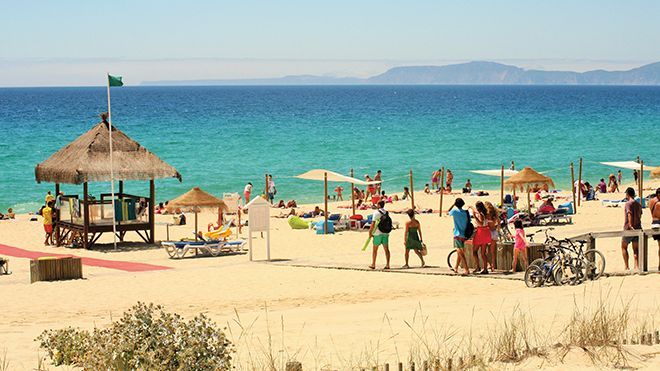
Shaped by its isolation and rural landscape, the “blue coast” appeals to the current lifestyle demands, which include a strong preference for low-density development. Although the market is still relatively small in volume, it attracts high-value buyers looking for land, privacy, and proximity to the beach.
In an interview with Managing Partner Nuno Durão and Marketing Manager Sandra Fernandes from IRG Fine & Country – Luxury Real Estate in Portugal, we take a closer look at this highly profiled area to better understand what kind of real estate movements are happening there right now. IRG Fine & Country is an agency with local offices in Comporta, Estoril and Lisbon and consists of around 22 employees. It was one of the first real estate agencies in Comporta, having opened its office back in 2014. In particular, the bankruptcy of the Portuguese bank BES accelerated transactions in the area.
In the Comporta area, IRG Fine & Luxury sold around 20 properties last year, with an average transaction value of about €1 million – ranging from €400.000 to a property of €15 million. Around 40% of the buyers are of Portuguese nationality. The strongest international groups are Brazilians, Americans and French. Curiously, it was previously Chinese and Turkish buyers who were looking into the area. The nationalities shift from year to year.
According to Durão, pricing is influenced mainly by structural factors such as construction costs, land prices, and taxes, rather than foreign demand. He suggests that foreign buyers with substantial capital represent about 2 pct. of the Portuguese real estate market. Since the Covid-19 pandemic, the land prices has increased significantly, and cost of construction has too because of demand of imported goods the, making it sometimes cheaper to build in Lisbon than in Comporta.
So, what are the typical buyer in Comporta, Carvalhal, Troia and Melides looking for?
They are often looking for walking distance to the beach, isolated quintas and properties in the pine forest. Because of the 2 km distance to the coast-rules fully residential beach front development is constrained. Tourist-oriented projects are more feasible, but a fully residential beach development is limited. Durão highlights that although it might not have been top-of-mind for buyers, condominiums are emerging as an often suitable solution as they offer maintenance and security for owners who might use their property mainly for holidays.
So, how is the future of the real estate market looking in the “blue coast”?
A new commercial area and improved infrastructure in Carvalhal will make it more accessible for year-round living, while still maintaining the sense of isolation and the beach landscape. Troia is also expected to ply an important role in the area’s future development. In regards to Melides, the area will according to Duraõ most likely be influenced by the high volume of industry projects in the deep-sea port of Sines. A positive spillover effect, which will create a lot of demand for housing and develop the infrastructure.
Lastly, IRG Fine & Country highlights that buyers should not let the few current beach accesses dictate the location of their next purchase, but look into where the new resorts will be placed. These resorts are obligated to create a public access road to the beach and several resorts are already in the making, making a broader part of the coast line highly attractive.








 English
 Nederlands
 Deutsch
 Français
 Español
 Italiano
 Svenska
 Pусский
 中文
中文 Türkçe
 Português
 Polski
 عربي
عربي Suomi
Suomi עִברִית
 Português (Brasil)