

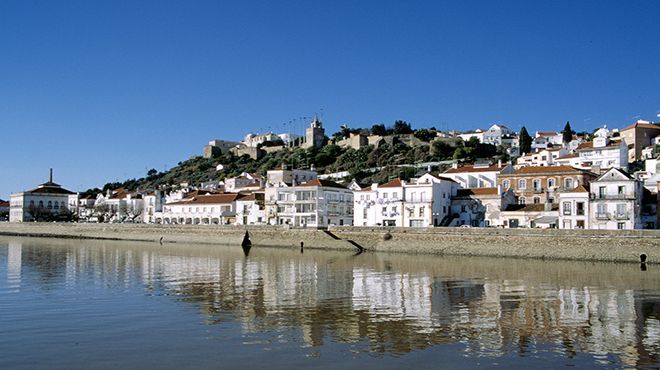
The work, valued at €1.2 million and financed by the Recovery and Resilience Plan (PRR), began in September 2025 and is scheduled for completion in July of this year, according to data provided to Lusa by the Cultural Heritage – Public Institute (IP).
The project
The project covers four sections of the wall, located above the city and the Sado River, in the Setúbal district, and aims to consolidate the structure, replace missing elements and improve the drainage of surface water.
During a visit to the ‘behind the scenes’ of the work, among wooden formwork, Miguel Rocha, from the architectural design team, explained to the Lusa news agency that the particularity of this project lies in the use of rammed earth in the original construction of the wall. “It’s not so different from other heritage works. What is different is the specific construction technique, which is a very little-known technique,” highlighted Miguel Rocha, who is a specialist in rammed earth construction.
Opting for rammed earth
The choice of rammed earth is also supported by Ângelo Silveira, head of the Cultural Heritage Institute, since it respects the structure's original nature.
“This wall is originally made of rammed earth,” although over time stone additions have been made, “convinced that this would give it more durability,” he said.
Therefore, he added, the current consolidation intervention also ends up functioning “as a rehearsal for future work on other sections of the wall.”
In the case of Alcácer do Sal, rammed earth is linked to the castle's history and to the reuse of materials on the site.
"The rammed earth was made with the earth that was on site," explained Miguel Rocha, recalling the proximity to the ancient Roman Forum of Alcácer do Sal and the incorporation of Roman elements in the construction of the wall.
An example of this is the marble sculptural element associated with a Roman toga, found during the intervention, which would have been reused to fill the structure of the wall's tower, explained André Nascimento, head of the company Empatia Arqueologia, Conservação e Restauro, to Lusa.
"We already have authorisation for it to be removed, as a safeguard measure," after the consolidation of the walls and the subsequent "stone filling," clarified the archaeologist, revealing that "ceramic fragments from various chronological periods" have also been found.
For this work, those responsible mix moistened earth with lime to increase the clay's stability. The mixture is then placed in layers inside wooden boxes and compacted until it gains strength.
“If done properly, it is a process with as many or more benefits than conventional construction today,” argued Miguel Rocha.
Speciality of the technique
The specificity of the technique makes the intervention more labour-intensive, shared Rafael Lopes, responsible for the execution of the works, with Lusa.
“It is very difficult to get workers. When we have a project of this type, we form work teams, because almost no one has sufficient knowledge of the technique, he acknowledged.
In addition to the consolidation of the wall, the drainage of surface water is one of the main concerns of the contract, mainly because it is a low area of the castle, where the water runs off.
“This is the lowest area of the entire castle. It was very important to also carry out a treatment here from the point of view of drainage,” said Albertina Rodrigues, a civil engineer from Cultural Heritage, responsible for monitoring the work, also during the visit.
When the intervention is complete, these technical specifics should go unnoticed by visitors to the castle.
But, for Miguel Rocha, this is also one of the signs of heritage conservation: "The first thing that [the public] won't notice is the technical dedication of some people" in this project.






 English
 Nederlands
 Deutsch
 Français
 Español
 Italiano
 Svenska
 Pусский
 中文
中文 Türkçe
 Português
 Polski
 عربي
عربي Suomi
Suomi עִברִית
 Português (Brasil)